Friday, April 25, 2008

Best Practices of Well-Formed Data?

Update 2008/05/06: It occurs to me now that this works for me due to my dependence on Western (American English) style characters: http://benfry.com/writing/archives/82... My concern is readability by humans and for me that means American English. Unicode is a super set, so I have modified my post accordingly.

I have come to realize that there are exactly three (3) formats for well-formed data which suit all of my interoperability needs:

  1. XML
  2. ASCII Unicode standard object notation
    1. (i.e., script object notation, i.e., SON, i.e., Object.property as text, ex. JSON)
  3. ASCII Unicode standard delimited notation
    1. (ex., comma-separated values)
Each of these has upsides and downsides.

Use XML when you want to be the most versatile with your data. Besides being ubiquitous, XML serializes and deserializes quickly and easily, represents OO clearly, and can be easily, automatically validated. XML presents itself well for both people and software. Especially use XML when you want to do advanced searches on data or transform the data from one domain-specific language (DSL) to another. DOM and XPath queries do lose their utility as data sets get large, but these situations can be avoided and parsing remains fast even on files many megabytes in size. Batch processing gigs of data is not a job for XML. (Use a relational database for that.)

Use SON when all you want to do is serialize/deserialize data to/from business objects or standard data structures (ex., arrays, maps). JavaScript Object Notation, or JSON, is super convenient for Javascript apps and JSON "liblets" (very small libraries, usually only 1 file) are easily found and maintained with your own code. SON also represents OO clearly, and given a pretty-print function, presents itself well to both people and software. But, there is currently no way to validate a SON. Not everything can handle a SON either. JSON doesn't work with languages that aren't JavaScript*, although there's nothing about JSON that is proprietary to Javascript so it's just a matter of time. JSON is just formatted text. ASCII Unicode-based SONs may one day be the XML killer but that time is a long way off.

Use CSVs when you want to be super fast on the throughput and can make assumptions that the data is simple to interpret. CSVs work well when moving very large amounts of data over a wire and/or into and out of relational databases. CSV data does not represent OO in any way, it does not present itself well to people, and there is no standard way to automatically validate it. CSV can be super efficient, but it is error-prone, can be difficult to debug, and is not nearly as versatile as the other two formats.

A good data service should support all three of these whenever and wherever it is feasible. And here is the obvious point that I do not want to escape from me - these 3 formats are all any data service ever need provide. Any service that supports each of these will be "universally" (practically) interoperable. If all data services supported exactly these 3 then all the Web would be an oyster.

*Update: over at JSON.org you can find ports for every language under the sun. Actually, what I meant is that support for JSON isn't native in the main platforms. Hopefully it will be built into all of these languages in the future.

Sunday, April 6, 2008

Is Google Search Appliance Appropriate for Government and Corporate Enterprises?

Question to Ponder (QTP)

Google's smarts are based on Page Rank, which is tied to popularity. Popularity on Google is heavily influenced by financial and other driving incentives. Google's strengths are based on Gi-normous machine clusters and on huge critical mass of the widest diversity of users, who are mixing it up and providing feed back into the system explicitly and implicitly by way of their behavior.

So is a Google search appliance a smart recommendation for government or corporate enterprise? I don't know exactly but last good info I had was that they cost about $150K per appliance rack that could search 2 or 3M items.  [Update 01.14.2009 - new box searches 10M docs]  One NASA center has two racks and found they chewed up 4-6M items in no time. I don't know what percentage that was, but I do know that they were want for more racks. Last I talked to them they were getting good at setting up filters to weed stuff out. (Weeding the garden is probably not a bad thing in any event.)

Now, I suppose you could - antitrust laws and fear not withstanding - scale Google's model to apply to the whole of the US federal government's information infrastructure and we'd approach some aspect of critical mass. Popularity behavior would surely be different than the commercial advertising model (I think). But that's not necessarily bad, if true.

It actually might not cost a lot of money in terms of federal budget scales. The way I figure, 1 billion records would cost $50M at full retail cost, i.e., no negotiated discount:

1,000,000,000 items/3,000,000 items per rack = 333 racks : 333*150,000 = 50,000,000

Tack on 20% to implement? +10M gets us to $60M
20% per year for maintenance? +10M per year * 10 years and we're at $160M

Double it all for 2B items. $320M. Even with no write downs for discount that's a rounding error in the federal budget.

To avoid monoply and other sticky issues with a deal like this, the government should buy Google's intellectual property and arrange a reseller license agreement so the government can contract out to the fairest qualified bidders (plural) the secure right to implement the IP on hardware on the government's behalf. Google could even be forbidden from competing in that way for some number of years. Government then leases time on the GIG to cover the bandwidth resources consumed by the huge clusters serving this purpose. (Ooh - is that in the cost?) Government already has the ability to secure this at multiple levels of security (Is that in the cost?). It is essentially, if perhaps not trivially, a matter of organizing search clusters to operate within NIPR or within SIPR or within JWICS firewalls.

[Update on 11 April based on conversation with Katharine: It might not be one big Google search farm pointed at these networks, at least not without a radical change in policy that may be intractable due to politics. There are many, many organizational firewalls. But at least get the bulk purchase order in, get a huge discount...for taxpayers, and place clusters where they need to be to get the biggest bang for those bucks. The essence is to take a strategic approach to search for the whole of government information. Search is so very fundamental that it deserves this kind of treatment.]

Ok...that demon thought is expelled now. I'm writing too many proposals. Approaching temporary burnout threshold. My brainstorming synapses may be totally misfiring at this point.


[Update 3 December 08:  2B searchable items is nary a drop in the bucket, I reckon.  Are we talking about 2 trillion?  200 trillion?  Large numbers that sound obscene when spoken?]

Wednesday, April 2, 2008

On Accessors and Mutators

I was just exploring the Google Visualization API reference and found myself a little hung up something. It's not just Google's API, but they are certainly a huge propagator of code. It's not the first time I've been hung up on this, either. The problem is that most APIs that use the Accessor/Mutator pattern follow it in the same, and in my opinion wrong, way. What is the point of declaring and implementing a unique function - no - two functions for every property contained by an Object? In fact why do we need any more than exactly two functions total to get or set any property or, in fact, any Object?

getColor()
getName()
getNumberOfColumns()
getNumberOfRows()

Why not just get(namedAttribute) and set(namedAttribute, value)?

get("color")
get("name")
get("numberOfColumns")
get("numberOfRows")
set("numberOfRows", 6);

Realize that 6 is probably not the literal integer 6, but rather an Object itself or perhaps a Collection (of size 1) containing literal, primitively typed values. But that is hardly of consequence in the scheme of things, it seems to me. I dread even having to make the case for efficiency. Programmers still get hung up on efficiency too much in terms of cycles and RAM. While I am sensitive to these concerns (for reasons of achieving enough throughput to support fluid user interaction) such concerns pale in comparison to what is lost overall to complexity of integration. How many API's do we want to learn, really? Domain-specific languages are much easier to learn and use, and more so when there aren't too many competing DSLs floating around a domain.

Perhaps I have it wrong and it is all a trivial point I am making. But it seems an awful waste of time doing it the other way. What kind of code bloat is being propagated? What happens when you add a new attribute? In fact, the ability to declare an arbitrary property and assign it to any Object is a powerful mechanism in software. It will be used and abused one way or the other so we should anticipate and handle it. But specifically, this kind of abstract polymorphism is ideal for serialization and deserialization of database records without having to tightly bind classes to database constructs through object relational mapping. Whether using XML, standard object notation, or standard delimited formats, there are multiple ways to deserialize any Object into memory for use by business logic without having to declare and implement a class for the Object.

In fact, one interface for get and one for set is much more flexible on the whole. Integration and interoperability with other programs is much easier with a single get/set. The ability for interoperating software programs to bind solely to a universal input/output protocol, and for interoperating software to remain blissfully unconcerned with the inner workings of peers is beyond powerful. Then we can focus on the functional roles of software. What does it do? I don't care how (beyond the I/O interface)(and I do care how well). When you get to that point, software can program other software (within a security model, of course). This kind of integration is also easier to maintain. Consider an implementation that uses XML as the carrier. The main Do-Until-Error loop is as simple as: While(Element is recognized) Process Element; Else Throw/Ignore (Unrecognized Element Error). A secondary error condition will exist in the event that expected inputs are no longer generated as outputs from peers*. In both cases, the situations are reduced to a matter of choosing how to process output from peers as it is provided and not also a matter of refactoring the interface between peers. It's all the UNIX command line applied to the Web. And I am certainly not the first or only person to have noticed.

* A third condition occurs when input is malformed

Monday, February 25, 2008

CAVE ETD


This movie (above) was a product of a class assignment from graduate school, co-developed by Hussein Suleman and Fernando Das Neves. Talented guys. Actually, they did most of the development. I was the CAVE SME but still a fairly green agile developer. The class was Dr. Ed Fox's Information Storage and Retrieval (archived). The assignment was a basic proof-of-concept for navigating the Electronic Thesis and Dissertation (ETD) digital library at Virginia Tech using a 3d virtual reality metaphor. This is probably first time I knew for sure that realistic physical metaphors for browsing large electronic collections is a complete waste of time. It's even worse when the digital collection does not map to any actual physical space (i.e., this isn't a model of the campus library) and that's usually the case. On the other hand, tagging virtual environments with contextual information can be quite useful. Keep in mind that this is screen capture from monitor, but we are in a 10 cu. ft room, fully immersed in a 3D environment. So if you then keep everything the same but change the use case...there might very well be some value in linking the contents of a digital library to a virtual environment as a way of enriching the environment. Instead of wandering through a library having a completely arbitrary "floorplan" conceived by the application developers you are looking at a piece of complex equipment inside a virtual power plant and you can click anywhere and link into the: parts catalog, component specification, training lesson...any digital content.  That would be more useful.

Friday, February 15, 2008

Visualization Doesn't Matter

Sense-making matters. I've always been cognizant of the fact that people without sight have exactly zero use for visualization. (Probably not 100% true, I bet.) The point is that there is nothing presumptive about visualization that makes sense-making possible. It is the human mind that makes sense-making have even meaning enough to give way to possibility. Communication matters, too. Certainly visualization makes communication possible by providing an entire medium/channel/wavelength such that when we lack it our communication may likely be impeded.

Obviously I think there is value in visualization. So why do I say it doesn't matter? Because visualization is never more than a means to an end. That end could be to have fun or it could be to make an important decision or it could be to send a message. But in any case, there can be 1001 means to achieving those ends and visualization is never more than one of them.

Why is this point worth understanding and remembering?

Selling. Working for customers. Providing a service to people. I am a computer scientist and a technologist and a visualization "guy" but my work and my business are all about people. Sometimes people forget what the word "technology" means.

And so when I'm talking to a customer about visualization and I find that we are talking too much about visualization then something is not right. We should be talking about the customer's wants, needs, pains in intellectual terms that are not constrained by any one means of achieving an end. It's up to me to decide how, where, why, and when visualization matters. That's what I'm getting paid to do.

Ok, so enough with the hand-waving. What is a practical example?

I have a customer who wants and needs to make an investment in visualization and part of his information technology capability. I know going in that the reason I am doing business with this customer is because he values visualization and knows he needs help integrating it into his IT portfolio. So I'm sitting down in front of him and giving him his first brief on what I am doing for him. Most of the hour long presentation (demonstrations, actually) is/are in terms of how visualization is used to present and interact with his domain data. He finds that all well and good in about 5 minutes, but what he really wants to know is "which of my problems does it solve?" And that's where it gets tricky. Because the answer is that visualizing domain information doesn't solve any problems de facto.

So do you want to talk about my visualization services or do you want to talk about your problems? What matters? I'm happy and comfortable discussing either. But in my business, people solve problems and it just so happens that my people are skilled at using visualization as a means toward that end.

Thursday, January 31, 2008

Social Network Portability or Portable Social Networks?

I find it wickedly ironic that all the worthwhile activity around social network portability and data portability is trumped by ordinary human behavior:

Note that what Julian asserts there is valid, in my opinion: a whole lot of thought and knowledge, both good and bad, was poured into SNP in the "early days." If the people have moved from one group to another then perhaps it is safe to assume the knowledge went with them. But if this group died and the other emerged...then what?

And if that weren't confusion enough:


So here we are trying to keep up with the conversation - which can be extremely difficult in active groups - and the conversation keeps moving...figuratively and literally.

"Wait. It's not just social network portability. It's ALL data portability. Let's all move up to data portability."

"But 'all' data portability is too big. There are too many facets. Let's all move down into the various facets (presumably according to our interests and perspectives)."

Down that path madness lies if one isn't careful. Managing the order of things when it comes to the Internet can drive one crazy enough as is.

I do admire them for trying. Progress is being made. Data portability is intensely important for connected computing and process interoperability.

Tuesday, January 8, 2008

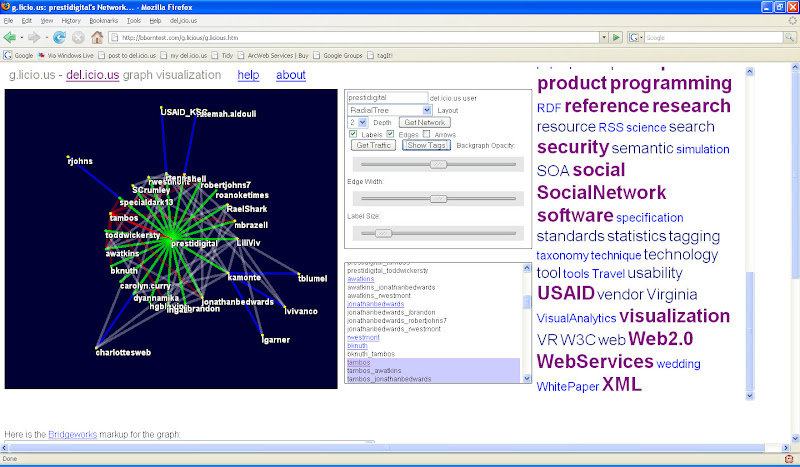
Latest g.licious

More noodling around...

From Bridgeworks